Freud by Élisabeth Roudinesco
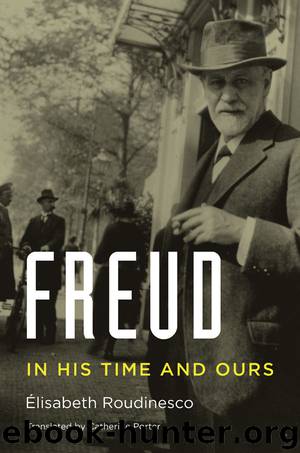
Author:Élisabeth Roudinesco [Roudinesco, Élisabeth]
Language: eng
Format: azw3, epub
ISBN: 9780674974517
Publisher: Harvard University Press
Published: 2016-11-14T05:00:00+00:00
PART FOUR
The Final Years
TWELVE
Between Fetish Medicine and Religion
AS MEDICINE BECAME more and more scientific, national governments found it increasingly necessary to regulate therapeutic activities. Although it was fully integrated into the field of medicine, psychiatry saw itself as all the more rational in its classifications in that it did not rely on the same clinical criteria as those used by the rest of the medical field. Nevertheless, in transforming a “crazy” person into a “case,” that is, into a “sick” person, it had come closer to traditional medicine in the sense that the subject was conceived simply as an object that could be entered into a nosographic framework. And it was on this terrain that Freud, coming out of neurology and psychology, had built his discipline as a branch of psychology, while also harking back to the dynamic tradition of Franz Anton Mesmer: magnetism, hypnotism, suggestion, catharsis, and finally transference.1 Psychoanalysis restored speech to the subject and relaunched the old idea according to which the patient, rather than the doctor, possessed the power to come to terms with mental suffering.
However, by creating institutions for the purpose of training practitioners throughout Europe and in the Western Hemisphere, after the First World War Freud and his disciples could no longer escape the regulations that various countries were gradually adopting in order to protect patients from pretenders, impostors, drug peddlers, and other unauthorized therapists known at the time as “charlatans.”
Every society, as we know, has a place for the figure of the charlatan, owing to the very fact that a society can only reproduce itself by clearly defining whom it includes and whom it excludes by virtue of the norms it has settled on. Thus a charlatan, whatever he or she is called, is always a figure of heterogeneity. Defined as “the accursed share,”2 charlatanism is what eludes reason or the logos: the devil, the excluded, the sacred, stains, instincts, the unmentionable. But by the same token it encompasses drugs (the pharmakon), the purveyor of drugs (the pharmakos), and the scapegoat or the martyr, who must be punished so that civil society can regenerate itself. A charlatan is thus a dual being, one who accepts a sanction and is at the same time the very condition of any sanction. Whether a poisoner or a healer, a tyrant or a miserable wretch, the charlatan is the other of science and reason, the other of ourselves.3 On this theme, Freud, a man of the dark Enlightenment who had been a cocaine enthusiast, found himself on familiar ground, between nostalgia and the practice of a scathing humor. He suffered more every day from the two-headed intruder that impeded his speech: the prosthesis that he called his “muzzle” and the cancer that was spreading inexorably.
Psychoanalysis, then, had been regarded by the medical authorities as a strange entity, as a charlatanic intrusion. After all, Freudian doctrine invoked Oedipus, a sage among sages but also a monster and a stain, even though the new movement had been created by a bourgeois elite: doctors, men of letters, lawyers, all holding university degrees.
Download
This site does not store any files on its server. We only index and link to content provided by other sites. Please contact the content providers to delete copyright contents if any and email us, we'll remove relevant links or contents immediately.
| Administration & Medicine Economics | Allied Health Professions |
| Basic Sciences | Dentistry |
| History | Medical Informatics |
| Medicine | Nursing |
| Pharmacology | Psychology |
| Research | Veterinary Medicine |
The Art of Thinking Clearly by Rolf Dobelli(10602)
The 5 Love Languages: The Secret to Love That Lasts by Gary Chapman(9903)
Mindhunter: Inside the FBI's Elite Serial Crime Unit by John E. Douglas & Mark Olshaker(9421)
Becoming Supernatural by Dr. Joe Dispenza(8278)
Nudge - Improving Decisions about Health, Wealth, and Happiness by Thaler Sunstein(7759)
The Road Less Traveled by M. Scott Peck(7663)
Mastermind: How to Think Like Sherlock Holmes by Maria Konnikova(7433)
Enlightenment Now: The Case for Reason, Science, Humanism, and Progress by Steven Pinker(7356)
Win Bigly by Scott Adams(7268)
The Way of Zen by Alan W. Watts(6673)
Factfulness: Ten Reasons We're Wrong About the World – and Why Things Are Better Than You Think by Hans Rosling(4793)
The State of Affairs by Esther Perel(4770)
Gerald's Game by Stephen King(4710)
Man's Search for Meaning by Viktor Frankl(4673)
The Confidence Code by Katty Kay(4317)
Thinking in Bets by Annie Duke(4287)
The Healing Self by Deepak Chopra(3639)
Hidden Persuasion: 33 psychological influence techniques in advertising by Marc Andrews & Matthijs van Leeuwen & Rick van Baaren(3600)
The Worm at the Core by Sheldon Solomon(3514)
